

Effectiveness of After-Action Reviews (AARs) and the Place of “Hot Debriefs”
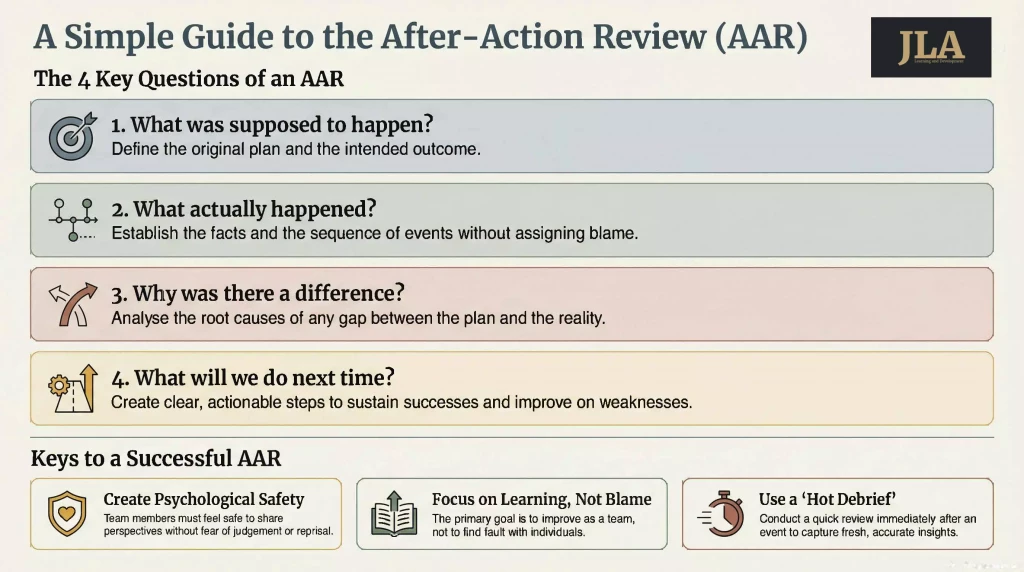
The After-Action Review (AAR) stands as a structured debriefing method, born from military practice and now common in business, designed to dissect what was intended, what transpired, the reasons for any discrepancies, and how future actions can be improved. JL Academy uses an adapted method which includes the principle of “Hot Debriefs” as one of their debriefing models. In this article, we dive a little more into relevant concepts of AARs and Hot Debriefs.
AAR Strengths
Structured Methodology: AARs bring a defined structure to reviewing events, ensuring that crucial elements are considered. This systematic approach aids teams in analysing their actions and pinpointing areas needing enhancement. The value of structured debriefing methods in promoting effective learning and performance improvement is highlighted in research by Ellis (2001).
Action-Focused: A key tenet of AARs is the creation of actionable steps for subsequent improvement. This emphasis on tangible outcomes renders AARs a valuable asset for organisations striving to boost performance and efficiency.
Fostering Continuous Improvement: Regular AAR implementation cultivates a culture of ongoing learning and adaptation within organisations. The process emboldens teams to reflect on their experiences, glean lessons, and implement changes to better future performance. Research supports the idea that AARs foster a culture of continuous improvement by enabling teams to learn from experience and adapt their practices (Kolb, 1984).
Considerations and Limitations of AARs
Formality Concerns: AARs can, at times, be perceived as overly formal, which might be a disadvantage in organisations favouring a more informal atmosphere. Adapting the AAR process to fit the specific context is vital, ensuring it doesn’t become an inflexible or bureaucratic exercise.
Depth of Analysis: While AARs excel at identifying performance gaps and action items, they might not always delve into the emotional or psychological dimensions of a situation. In scenarios involving trauma or significant emotional impact, alternative debriefing models, such as Critical Incident Stress Debriefing (CISD), might be more suitable or used in conjunction with AARs.
Implementation Quality: AAR effectiveness hinges on implementation quality. To maximise benefits, it’s essential to train team members in the AAR process, conduct debriefings in a safe and supportive environment, and ensure actionable insights are documented and applied.
The Role of “Hot Debriefs” in AARs
“Hot debriefs” refer to conducting a debriefing immediately or very soon after an event. In the context of AARs, hot debriefs can be a valuable component.
Benefits of Hot Debriefs:
- Immediacy and Accuracy: Hot debriefs capture information while it’s fresh in participants’ minds, enhancing recall accuracy.
- Timely Identification of Issues: They allow for the swift identification of critical issues that need immediate attention.
- Reinforcement of Learning: Hot debriefs reinforce learning points promptly, aiding in knowledge retention and application.
- Integrating Hot Debriefs into AARs: Hot debriefs can be used as a preliminary step within the broader AAR framework. A quick hot debrief immediately after an event can capture initial observations and insights, which can then be further explored in a more comprehensive AAR conducted later.
- Essential or Optional? While hot debriefs offer clear advantages, they aren’t strictly essential for every AAR. The necessity of a hot debrief depends on factors like the event’s complexity, the need for immediate action, and the team’s availability. However, incorporating hot debriefs as a standard practice can significantly enhance the effectiveness of AARs.
Research and Best Practice
Research affirms the value of AARs as a tool for learning and boosting performance. Studies indicate AARs can lead to improved team performance, enhanced problem-solving, and increased knowledge sharing.
To optimise AAR effectiveness, best practice underscores:
- Facilitation Expertise: Skilled facilitation is key to guiding the AAR process, ensuring all team members contribute, and fostering constructive discussion.
- Psychological Safety: A psychologically safe environment is paramount for effective debriefing. Team members must feel comfortable sharing perspectives and experiences without fear of judgement or reprisal. This aligns with findings that emphasise the role of psychological safety and a focus on learning in successful AAR implementation (Edmondson, 1999).
- Learning-Centric Approach: The primary focus of AARs should be on learning and improvement, not on assigning blame. A learning-oriented approach encourages open dialogue and cultivates a growth mindset.
AARs are a valuable debriefing model for enhancing learning and performance. While well-suited for analysing operational effectiveness, it’s crucial to consider the context and adapt the approach accordingly. Hot debriefs can be a beneficial addition to the AAR process, providing timely insights and reinforcing learning.
If you want more information on how JL Academy can help embed debriefing into your organisation, get in touch through By clicking here or use download our 15 Minute Blameless Debrief
James Hourihan BScEcon, MScEcon, FRSA, MIoD
References
Edmondson, A. (1999) Psychological safety and learning behavior in work teams. Administrative Science Quarterly, 44(2), pp. 350-383.
Ellis, D.P. (2001) Learning from failure: the after-action review. Quality Management Journal, 8(3), pp. 8-21.
Kolb, D.A. (1984) Experiential learning: Experience as the source of learning and development. Englewood Cliffs, NJ: Prentice-Hall.