

Introduction
The Department for Education’s updated guidance on restrictive interventions in schools (see below) represents the most significant regulatory shift in behaviour management since 2013. For school leaders, this isn’t just another policy document to file away—it’s a fundamental reframing of how we understand, document, and reduce restrictive practices in educational settings.
The new statutory duties come into full effect in April 2026. While this gives you time to prepare, the cultural shift required is substantial.
At JL Academy, we have a unique advantage in helping you navigate this. Our founder, James Hourihan, also founded Timian Learning and Development and authored the specific training programme we deliver. This means we aren’t just delivering a third-party course; we are delivering a programme built from the ground up by one of the UK’s leading experts to meet these exact challenges. This deep expertise ensures our BILD ACT certified training is perfectly aligned with the frameworks this guidance now expects.
WHAT YOU’LL LEARN:
- The five critical changes in the new guidance
- Why generic training is now a liability risk
- Implementation timelines and requirements
- Practical frameworks for compliance
- How to avoid common pitfalls we’ve seen in early adopters
Understanding the Regulatory Context
WHY THIS GUIDANCE MATTERS NOW
The shift in government guidance doesn’t exist in a vacuum. It’s the culmination of several converging pressures:
- Increased Scrutiny: Ofsted’s revised framework places greater emphasis on safeguarding and behaviour culture.
- Legal Precedent: The guidance explicitly links school policies to the Human Rights Act 1998 and Equality Act 2010, raising the stakes for non-compliance.
- Mental Health Crisis: The surge in student mental health needs means traditional behaviour management approaches are no longer fit for purpose.
- Inclusion Agenda: With the focus on keeping students in mainstream education, schools must demonstrate they can safely support students with complex needs without defaulting to physical intervention.
THE EVIDENCE BASE
Research from the Restraint Reduction Network shows that schools implementing comprehensive positive behaviour management frameworks see:
- 40-60% reduction in restrictive intervention incidents within 12 months
- Improved staff retention and reduced sick leave
- Better outcomes for students with SEND
- Reduced complaints and legal challenges
The new guidance embeds this evidence-based approach into regulatory expectations.
The Five Critical Changes
1. PREVENTION-FIRST EXPECTATION
What’s Changed: The guidance states schools “should proactively minimise the need to use restrictive interventions”. While not a strict legal mandate, the guidance emphasises that restrictive intervention must be “necessary” and “proportionate”.
What This Means in Practice:
- Your behaviour policy must outline clear prevention and de-escalation protocols.
- The guidance suggests “whole-school measures” like environmental changes and relationship building.
- Incident reports should document what prevention strategies were attempted.
Implementation Action: Audit your current behaviour policy. Does it jump from verbal warning to physical intervention? The new guidance expects a documented hierarchy of preventative steps.
2. ENHANCED RECORDING DUTIES (STATUTORY)
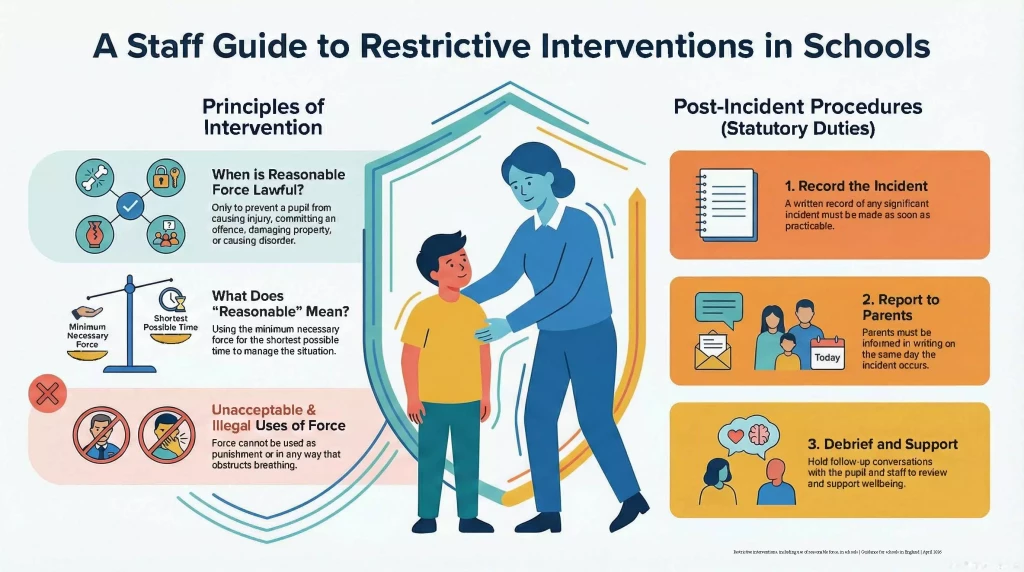
What’s Changed: The guidance makes recording “significant incidents” a statutory legal duty. It also introduces a new specific duty to record “Seclusion” and “Restraint” (even non-physical restraint like removing a walking aid).
Key Requirements:
- Same-Day Reporting: Schools must “endeavour” to record incidents and notify parents “no later than the same day”.
- Detailed Metrics: Records must include the “approximate duration,” “degree of force,” and a “brief account of why the use of force was assessed as necessary”.
- Physiological Monitoring (Best Practice): While the statutory list is minimal, the guidance warns against restraint affecting “airway, breathing or circulation”. JL Academy recommends recording physiological monitoring to prove you avoided these specific dangers.
Implementation Action: Your incident report templates need immediate revision. Download our compliant template that meets all new requirements.
3. THE PROOF OF SAFETY (Why BILD ACT Matters)
What’s Changed: The guidance places the absolute responsibility on school leaders to ensure training is “safe, appropriate and lawful”. It explicitly states that training must “reflect the principles of this guidance”.
The Compliance Trap: The guidance allows leaders to choose their training, but this creates a liability trap. If an incident occurs, how do you prove your generic training was “safe and lawful”?
The Solution: This is where the Restraint Reduction Network (RRN) Training Standards come in.
- Specific School Focus: The RRN Standards include specific protocols for educational settings, covering everything from “underdeveloped anatomy” in children to the risks of “seclusion rooms”.
- Independent Verification: Our training is certified by Bild ACT, which is accredited by UKAS (the UK’s national accreditation body).
The Bottom Line: While the DfE trusts you to choose, choosing a BILD ACT certified provider is the only way to objectively demonstrate you have met the statutory duty for safe, lawful, and rights-based training.
4. GOVERNANCE AND DATA OVERSIGHT
What’s Changed: Governing bodies now have a specific duty to “regularly review and interrogate data” on restrictive interventions.
New Governance Expectations:
- Identify patterns and trends in behaviour data.
- Check for “disproportionate use” on pupils with protected characteristics or SEND.
- Use data to “identify and implement improvements” to policies.
Implementation Action: Create a governor dashboard that tracks incidents by type, location, and student demographic to satisfy this new interrogation duty.
5. PUPIL WELFARE AND RECOVERY
What’s Changed: The guidance explicitly advises against “No Contact” policies but emphasizes that physical contact must be for the child’s welfare.
Key Provisions:
- Medical Assessment: Pupils (and staff) should receive medical attention for any injuries “as soon as possible”.
- Debriefing: Schools should hold follow-up conversations to “facilitate reflection, learning and to support pupil and staff wellbeing”.
- No “Pain Compliance”: The RRN Standards (which our training follows) explicitly forbid using pain to gain compliance, aligning with the DfE’s focus on proportionality.
Legal Implications for School Leaders
DUTY OF CARE VS. PROPORTIONALITY
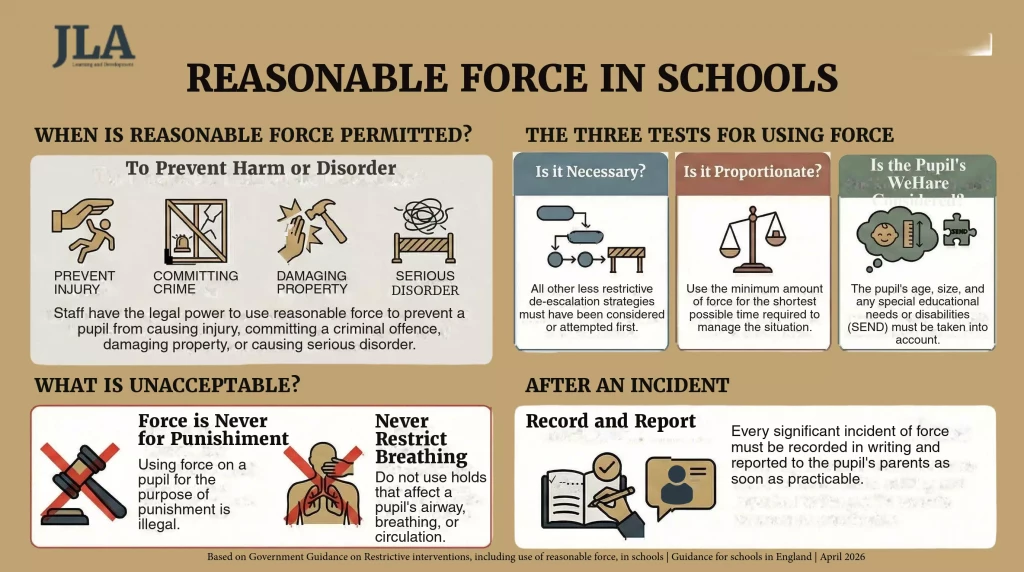
The guidance reinforces the legal tension school leaders must navigate: the duty of care to protect all students whilst ensuring any intervention is proportionate and necessary.
The “Reasonable” Test
The guidance defines reasonable force as “using no more force than is necessary for the least amount of time”. To defend your actions in 2026, you must prove:
- Necessity: Was it to prevent injury, damage, or disorder?
- Proportionality: Was it the least force for the shortest time?.
- Competency: Was the staff member trained to assess this risk safely?
Failing any of these tests creates legal exposure.
Implementation Framework: The Four-Phase Approach
Based on our work with schools successfully implementing the new guidance, here’s our proven framework:
PHASE 1: AUDIT AND GAP ANALYSIS (WEEKS 1-2)
- Policy Review: Compare current behaviour policy against the new “prevention and de-escalation” requirements.
- Training Audit: Check if your current training is certified. If it’s not BILD ACT certified, you may struggle to prove it meets the “safe and lawful” standard.
- Data Analysis: Extract 12 months of data to identify the “patterns and trends” your governors will need to see.
PHASE 2: STRATEGIC PLANNING (WEEKS 3-4)
- Restraint Reduction Targets: Set measurable goals to reduce the use of force (we typically see 20% reduction year-on-year as realistic).
- Training Plan: Schedule BILD ACT certified training. Our RRN-compliant courses cover the specific “underdeveloped anatomy” and “physiological monitoring” risks highlighted in the standards.
PHASE 3: IMPLEMENTATION (MONTHS 2-4)
- Staff Training: Deliver foundation training in positive behaviour management and trauma-informed practice.
- System Changes: Roll out new recording templates that include fields for “duration” and “reason for force” to meet statutory duties.
- Parent Protocols: Establish a system for same-day written notification to parents.
PHASE 4: MONITORING AND CONTINUOUS IMPROVEMENT (ONGOING)
- Data Review: Monthly analysis of restrictive intervention data.
- Governor Reporting: Submit the required data reports for governing body interrogation.
Common Implementation Pitfalls
PITFALL 1: “COMPLIANCE THEATRE”
The Problem: Schools update paperwork but practice remains unchanged.
The Solution: Training must focus on changing practice. Our approach embeds psychological safety principles so staff feel supported to use de-escalation even when it takes longer.
PITFALL 2: UNVERIFIED TRAINING
The Problem: Using generic “positive handling” training that isn’t accredited.
The Solution: The DfE requires training to be “safe and lawful.” BILD ACT certification is the industry gold standard for proving safety. Without it, you are self-certifying your own safety.
PITFALL 3: POOR RECORDING
The Problem: Missing the “same day” reporting deadline or failing to record “non-physical” restraints like seclusion.
The Solution: Streamline templates and integrate with existing safeguarding systems. We provide templates that meet requirements without duplication.
The Road Ahead: Making This Sustainable
Compliance with the new guidance isn’t a one-time project—it’s a sustained commitment to culture change. Schools that succeed are those that:
- Invest in Internal Capacity: Through train-the-trainer models, create a core team of certified trainers.
- Make Data Visible: When restraint reduction data is shared openly (with safeguards), it drives improvement.
- Link to School Improvement: Restraint reduction correlates with better relationships and stronger learning outcomes.
How JL Academy Can Support Your Implementation
We’ve supported over 200 schools through behaviour management transformations. Because our founder, James Hourihan, also founded Timian Learning and Development and authored the training programme himself, our support is uniquely robust:
- Direct Author Expertise: You aren’t getting a diluted version of a course; you are getting training delivered by the team that wrote the programme.
- BILD ACT Certified Training: Providing the independent verification you need to prove your training is safe and lawful.
- Psychological Safety Frameworks: We build the culture that makes restraint reduction possible.
- Bespoke Implementation Support: From policy writing to governor training.
Conclusion: Leading, Not Following
The schools that will thrive under this new guidance are those who see it not as a compliance burden but as an opportunity to genuinely improve safety. The evidence is clear: restraint reduction strategies work.
Next Steps:
- Download our free compliance checklist
- Book a no-obligation audit consultation
- Review our BILD ACT certified training dates
About the Author: James Hourihan is the founder of JL Academy. He also founded Timian Learning and Development and is the author of the BILD ACT certified training programme used by schools and organisations across the UK. With over 30 years’ experience in positive behaviour management, James helps schools build safe, high-performing teams.